Scrapping business class could halve aviation emissions – new study
Huge efficiency gains are available to airlines, without any new technologies – new study.
Milan Klöwer, NERC Independent Research Fellow, University of Oxford
24 February 2026
Air travel is famously one of the hardest sectors to decarbonise, and the number of air passengers keeps increasing. Electric planes and “sustainable” aviation fuels are still a long way off making a dent in the industry’s emissions – if they ever will.
But new research by me and my colleagues shows aviation could still cut its climate impact dramatically, simply by using planes more efficiently. In fact, rethinking cabin layouts alone could slash emissions by up to half.
From 1980 to 2019, the share of occupied seats in commercial air planes increased from 63% to 82%. Airlines already have strong commercial incentives to sell every seat – empty ones cost money as well as carbon.
For any given level of passenger travel, carrying more people on each flight means other planes can stay grounded and fewer flights are needed overall. It’s planes that make the big difference, not people – the additional weight of a passenger and their luggage is negligible relative to the aircraft and its fuel.
Aviation is responsible for 2%-3% of global CO2, but its contribution to global warming is about 4% when secondary effects like condensation trails (which trap heat) are factored in. This impact is dominated by rich people flying frequently, often long-haul in business and first class or even private.
Efficiency in aviation is often thought of as an engineering challenge: how much thrust an engine generates for a given amount of jet fuel. But operational efficiency – the amount of passenger-kilometres per unit of CO2 emitted – has received far less attention.
In our research, my colleagues and I calculated this operational efficiency for the year 2023, for every flight route, by airline, aircraft model and airport. We found that efficiency gains available in the short term could reduce aviation’s climate impact by more than half.
Short empty flights are the least fuel-efficient
On average, aviation emissions fell from around 260 grams of CO2 per paying passenger-kilometre in 1980 to 90 grams in 2019. That’s a big difference, but for comparison, electrified rail powered by low-carbon energy can emit less than 5 grams.
Our analysis shows that CO2 efficiency varies enormously across routes, regions, airports, airlines and aircraft models. Some flight routes emit more than 800 grams per passenger-kilometre, others less than 50. This variability is staggering but also yields a large potential to reduce emissions if efficiency across the industry increased towards that of the most efficient routes we analysed.
Among the highest emitting countries, many of the least efficient flights start or land in the US, followed by China, Germany and Japan. Inefficient flights are common elsewhere, particularly from or to smaller airports, and in Africa and Oceania, often exceeding 140g per passenger-kilometre.
By contrast, more efficient flights – below 100 grams per passenger-kilometre – are common in Brazil, India and south-east Asia, particularly on high volume routes. Europe contains a mix of both.
These differences can be explained by the share of occupied seats, the aircraft models used on a route and the cabin layout – especially the space allocated for business and first class.
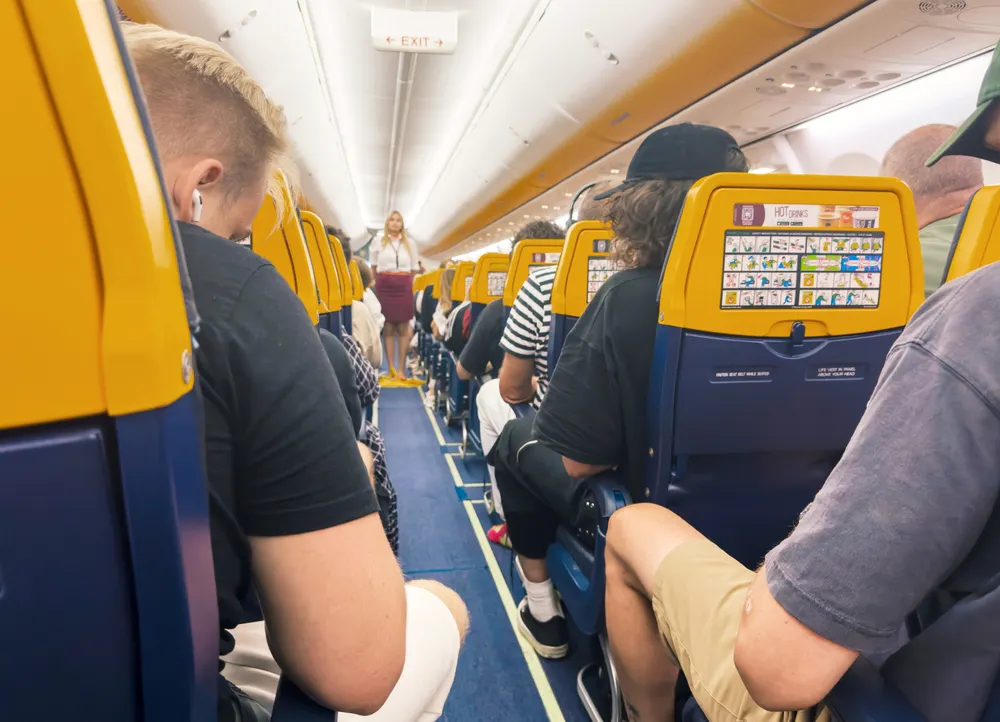
Budget airlines tend to be more efficient as they seat as many passengers as possible. Spacious business or first class seats are often removed and revenue is instead generated through services such as baggage, food or booking flexibility – all of which add little to flight emissions.
Budget airlines tend to fill their seats.Katarzyna Ledwon / shutterstock
We also found a few newer aircraft models to be the most efficient in operation (Boeing 787 Dreamliner and Airbus 320neo, both in several variants) averaging less than 65 grams of CO2 per passenger-kilometre. However, they are not (yet) the most widely used, partly because aircraft typically remain in service for around 25 years.
Long-haul flights are on average more efficient than shorter flights. Take-off emissions only occur once, and larger aircraft with more seats are typically used on longer routes. For similar reasons, larger airports tend to have lower average emissions per passenger.
Increasing air travel efficiency
We modelled three hypothetical scenarios to illustrate the potential of certain operational changes, recalculating the total emissions after each change.
First, we increased the average passenger load factor from 80% to 95%. This alone would cut emissions by 16%, as fewer flights would be needed to carry the same number of passengers. While this is already in airlines’ interests, creating additional incentives – such as emissions-linked airport charges or fuel taxes – could encourage further gains.
Second, we imagined only the two most efficient aircraft (Boeing 787-9 and Airbus A321neo) were in operation. Aircraft cannot be replaced overnight, given their long service lives, and the industry hasn’t built enough 787-9 or A321neo yet anyway. But choosing already existing aircraft highlights the potential of replacing older aircraft with newer and more efficient ones – in our calculations, it would save between 27% and 34% of global emissions. This would also require overcoming logical and commercial constraints, again potentially incentivised by airport or fuel charges.
Third, we analysed the impact of an all-economy cabin layout. Business and first class seats are up to five times more CO2-intensive than economy seating because they occupy far more space per passenger. Operating all aircraft at the manufacturers maximum seating capacity would reduce global aircraft emissions by between 26% and 57%.
There are already large differences between airlines. Some chose to set up their Boeing 777-300 ERs with more than 400 economy seats, while others have as few as 200, despite a maximum seating capacity of 550.
Our findings highlight how strongly aviation emissions are shaped by travel inequality between occasional economy fliers and frequent business and first class travellers. Many of those may complain about the inconvenience of economy class. But perhaps that’s not a bad thing: it could create an even stronger incentive to reduce the number of non-essential journeys.
Milan Klöwer receives funding from the Natural Environment Research Council.
This article is republished from The Conversation under a Creative Commons license.